From island biogeography to habitat fragmentation
Since the advent of the theory of island biogeography, ecologists have often framed fragmented terrestrial landscapes as ecological archipelagoes, using the theory as a powerful null model to explore biodiversity patterns. While invaluable, its broad application has sometimes reduced diversity analyses to formulaic curve-fitting, overlooking species-specific responses.
Our research at Lake of the Woods, Canada, leverages natural island systems to test the relevance of island biogeography and related theories to terrestrial fragmented landscapes. While fragmentation is widely seen as a major conservation concern, some argue that total habitat amount—not patch size or isolation—drives species persistence (“the habitat amount hypothesis”). We critically examine this debate by assessing whether diversity-based approaches obscure individual species’ responses, which ultimately structure biodiversity (hint: they do!).
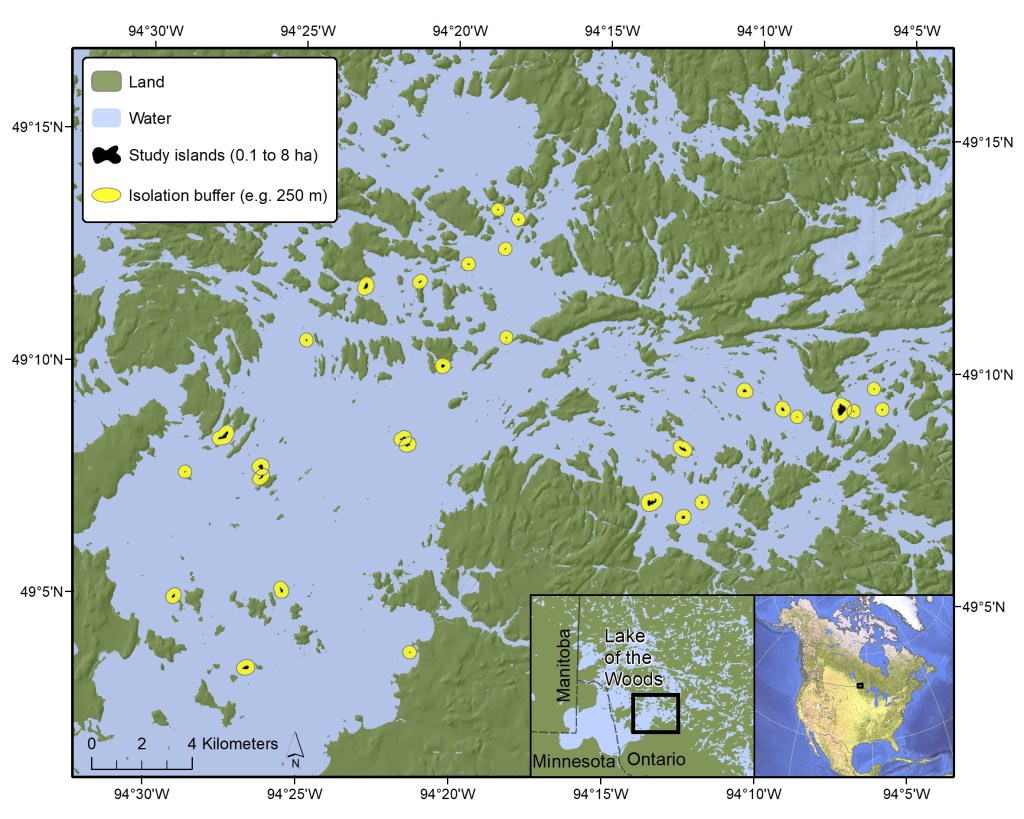
By integrating traditional and emerging frameworks, we explore how different metrics—species counts, relative abundance, and entropy-based measures—shape conservation insights. Our work on butterfly, bird, and plant assemblages from true and ecological islands aims to refine diversity measurement tools and ensure broad-scale analyses do not mask species-specific declines.
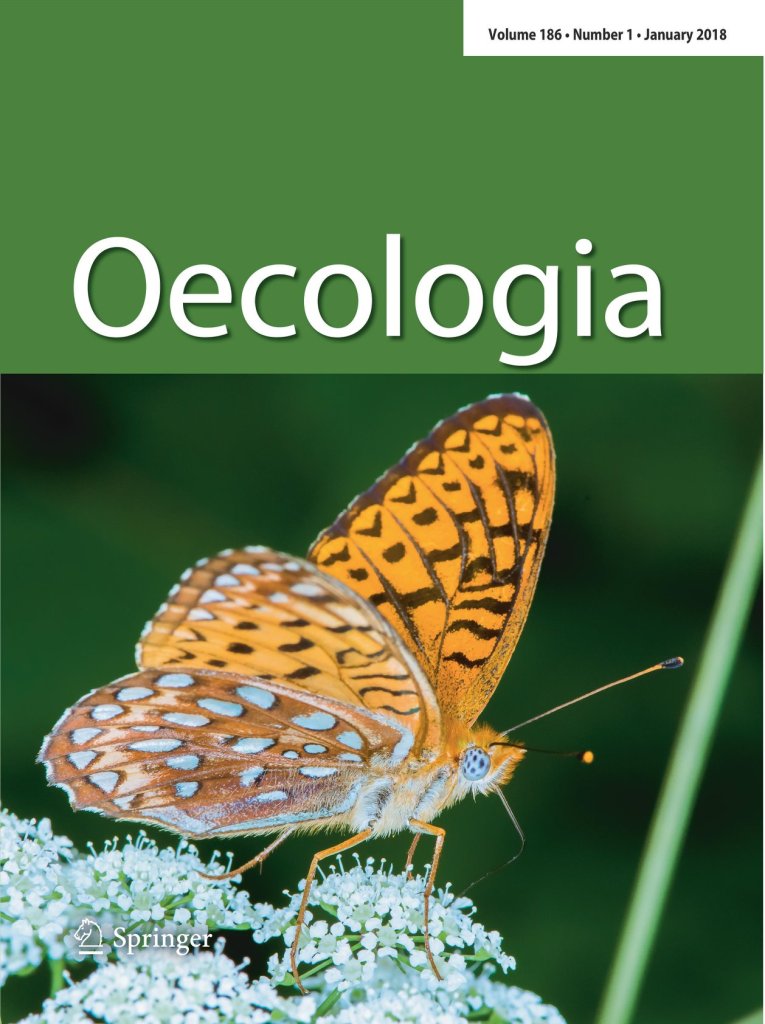
Here are some of our publications on habitat fragmentation vs habitat loss and movement of animals through fragmented landscapes:
MacDonald, Z.G., Anderson, I.D., Acorn, J.H., Nielsen, S.E. (2018) Decoupling habitat fragmentation from habitat loss: butterfly species mobility obscures fragmentation effects in a naturally fragmented landscape of lake islands. Oecologia. 186(1): 11-27. Cover article and awarded Hanski Prize for best student-led paper in animal ecology.
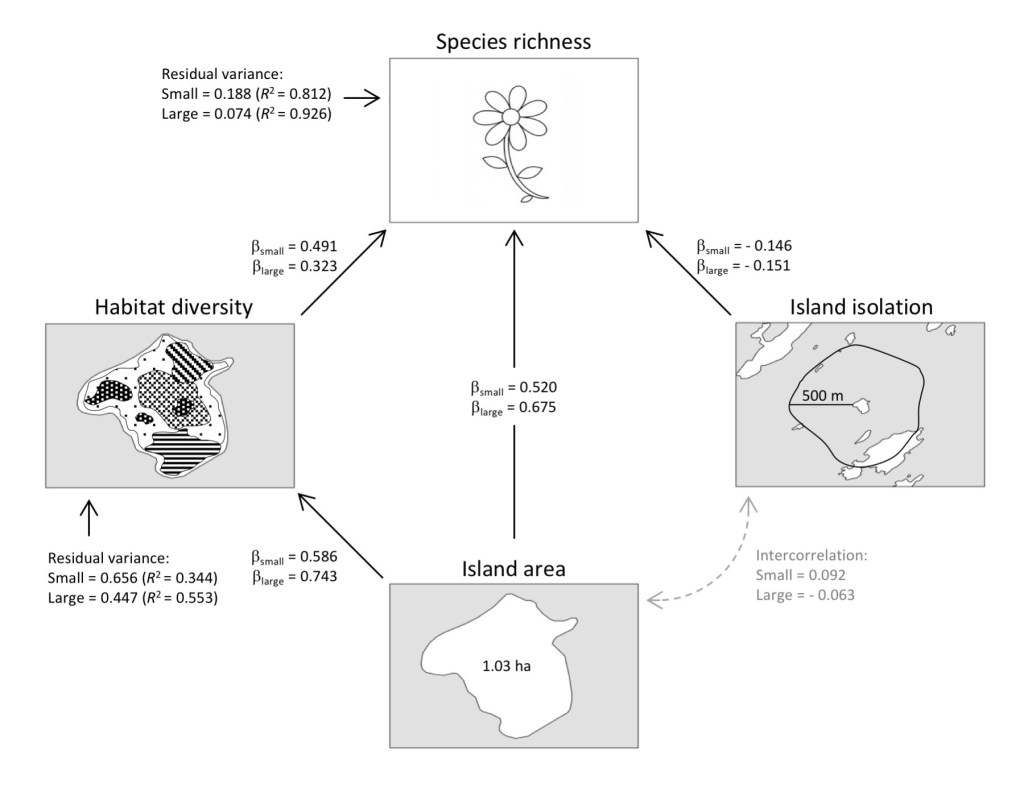
MacDonald, Z.G., Anderson, I.D., Acorn, J.H., Nielsen, S.E. (2018) The theory of island biogeography, the sample-area effect, and the habitat diversity hypothesis: complementarity in a naturally fragmented landscape of lake islands. Journal of Biogeography. 45: 2730-2743.
MacDonald, Z.G., Acorn, J.H., Zhang, J., & Nielsen, S.E. (2019) Perceptual range, targeting ability, and visual habitat detection by greater fritillary butterflies Speyeria cybele (Lepidoptera: Nymphalidae) and Speyeria atlantis. Journal of Insect Science. 19(4), 1.
MacDonald, Z.G., Deane, D.C., Lamb, C.T., He, F., Acorn, J.H., Nielsen, S.E. (2021) Distinguishing effects of area per se and isolation from the sample-area effect for true islands and habitat fragments. Ecography. 44(7), 1051-1066.
Liu, J., MacDonald, Z.G., Si, X., Wu, L., Zeng, D., Hu, G., … & Yu, M. (2022). SLOSS‐based inferences in a fragmented landscape depend on fragment area and species–area slope. Journal of Biogeography, 49(6), 1075-1085.
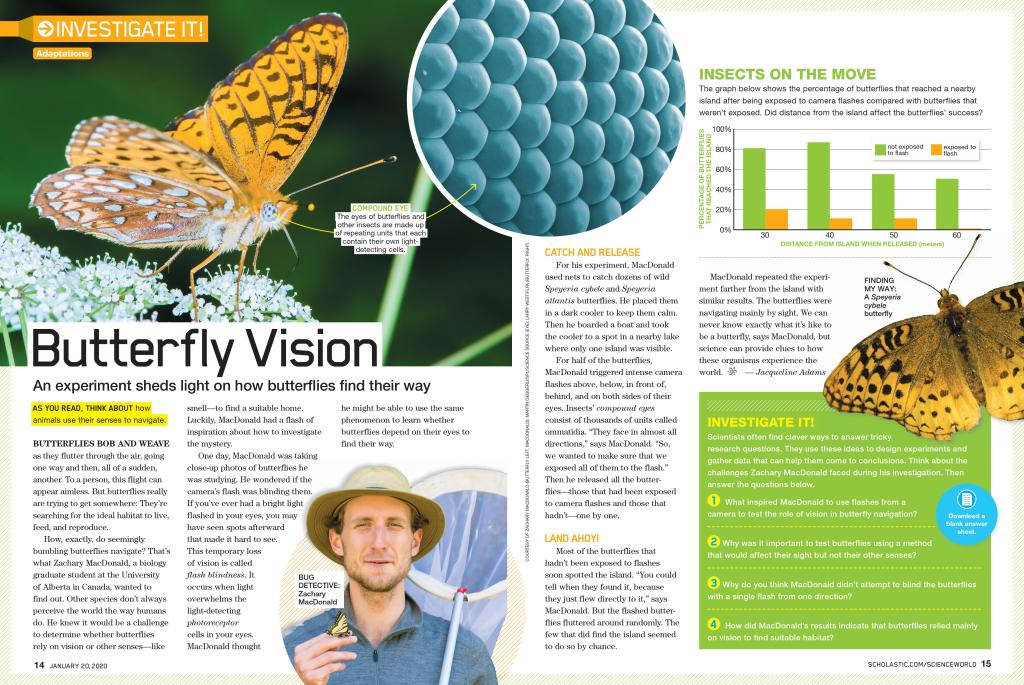
Scholastic Magazine highlighted our research on how butterflies use vision to navigate fragmented landscapes. What it is like to be a butterfly?
 Zac's Research Website